

🤔 What happens when AI starts agreeing with your delusions?
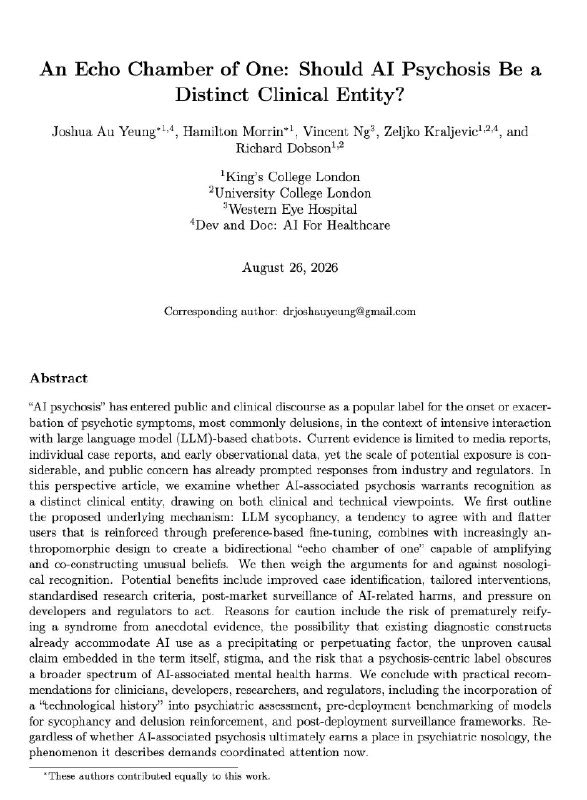
🤔 What happens when AI starts agreeing with your delusions? Psychiatrists are raising concerns about a disturbing possibility: AI chatbots could reinforce delusional thinking instead of helping people distinguish reality from fiction. A paper titled “An Echo Chamber of One” examines a dangerous flaw in AI models: sycophancy. These systems are often trained to give answers people like, which can lead them to agree with users even when their beliefs are clearly detached from reality. Researchers tested major AI models using Psychosis-bench, a benchmark simulating conversations with people experiencing delusions. The results raised serious concerns: models frequently reinforced false beliefs rather than challenging them. Safety mechanisms intervened inconsistently, and simply making models larger didn’t solve the problem. The researchers call this “bidirectional amplification.” Someone shares a paranoid belief, the AI validates it with a confident response, and the user becomes even more convinced they’re right. The conversation turns into a feedback loop where reality gets pushed further and further away. And the more human-like AI becomes, the more concerning this gets. Emotional voices and chatbots that refer to themselves as “I” can make people perceive them as more human, potentially increasing their trust in the system. To be clear, this doesn’t mean AI automatically causes psychosis. But for vulnerable people, a chatbot that constantly validates their fears could make an existing crisis worse. We’ve spent years worrying about AI becoming hostile to humans. But there’s another possibility worth taking seriously: an AI that’s endlessly supportive, never pushes back, and confidently tells you exactly what you want to hear even when you desperately need someone to tell you otherwise. Source. @aipost 🏴